Meniscus Tear: Surgery or Conservative Treatment?
Not every meniscus tear needs surgery. Learn about the types of tears, their symptoms, how they're diagnosed, and when physical therapy, repair or knee arthroscopy is recommended.
4 min read
“They told me I tore my meniscus. Do I need surgery?” It’s one of the most common questions in an orthopedic office. The short answer: it depends. A meniscus tear may be treated with therapy and exercise, with a surgical repair or, in some cases, by removing only the damaged portion. The right decision depends on the type of tear, your symptoms, your age, the overall health of the knee, and what you want to get back to doing.
What is the meniscus?
Each knee has two menisci: the medial meniscus (inner side) and the lateral meniscus (outer side). They’re C-shaped pieces of fibrocartilage that sit between the femur and the tibia. They act as shock absorbers, help distribute load across the cartilage, and contribute to knee stability.
Because the meniscus protects the cartilage, preserving it whenever possible is an important principle in modern orthopedics.
Types of tears
Traumatic tears
These typically happen in young, active people when they twist or pivot on a planted foot — playing basketball, soccer, softball or volleyball, for example. They sometimes occur alongside other injuries, such as an anterior cruciate ligament (ACL) tear.
Degenerative tears
These develop over the years as meniscus tissue becomes less elastic. The meniscus can tear with a simple movement, like standing up from a squat, or with no clear event at all. They commonly coexist with knee arthritis.
Tears are also described by their pattern (radial, horizontal, longitudinal, “bucket-handle,” root tears and others) and their location. The outer portion of the meniscus has a better blood supply and therefore a greater potential to heal after a repair.
Symptoms of a meniscus tear
- Pain along the joint line, on the inner or outer side of the knee.
- Swelling that often appears hours after the injury or the next day.
- Stiffness and difficulty fully bending or straightening the knee.
- A catching or clicking sensation when moving it.
- Locking: the knee gets “stuck” and you can’t fully straighten it.
- A feeling that the knee gives way.
How is it diagnosed?
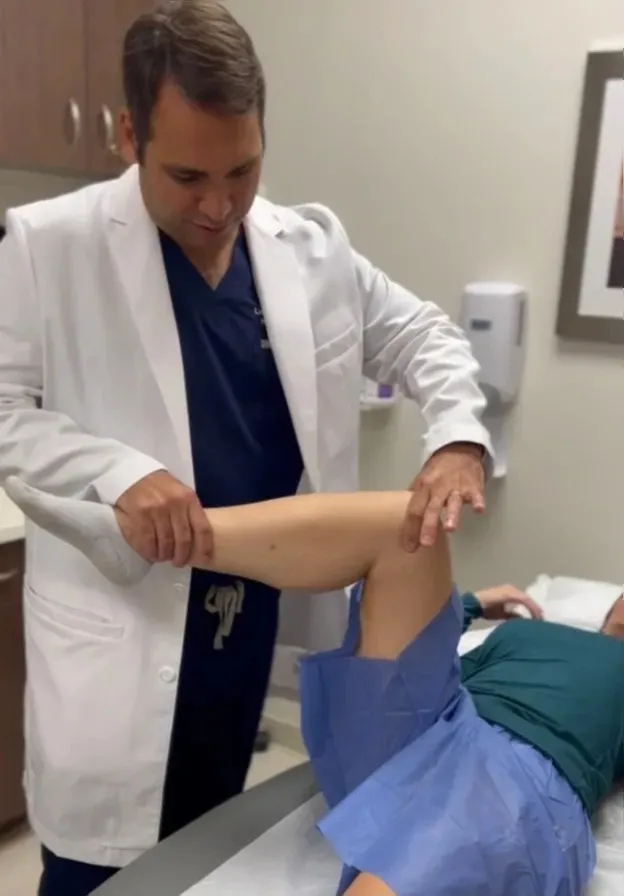
Diagnosis starts with a good history and a physical exam of the knee. The specialist checks for tenderness along the joint line and performs specific maneuvers that can reproduce meniscus symptoms.
X-rays don’t show the meniscus, but they’re important for evaluating bone, alignment and arthritis. MRI is the test that best shows the meniscus and other structures like ligaments and cartilage.
A key point: in middle-aged and older adults, it’s common to find degenerative tears on MRI that aren’t the cause of the pain. That’s why imaging is always interpreted together with your symptoms and exam.
Conservative treatment: when it makes sense
For many patients — especially those with degenerative tears and no true locking — non-surgical care is the recommended first step. Clinical studies have found that in many of these cases, physical therapy can provide results comparable to arthroscopy for relieving pain and improving function.
Conservative treatment may include:
- Relative rest and avoiding impact or pivoting activities while the knee settles down.
- Ice and elevation to control swelling.
- Physical therapy to strengthen the quadriceps, hamstrings and hip, and to restore motion.
- Anti-inflammatory medication for short periods, if your doctor considers it appropriate.
- Knee injections in selected cases, particularly when arthritis is also present.
Many people improve within weeks to months. If symptoms persist, the plan is reassessed.
When surgery is considered
Surgery is usually considered when:
- The knee is locked or catches repeatedly (for example, with a bucket-handle tear).
- It’s a traumatic tear in a young, active person with good repair potential.
- There’s a meniscus root tear, which can significantly affect how the meniscus works.
- Mechanical symptoms or pain don’t improve after an adequate period of conservative care.
- There are associated injuries, such as an ACL tear, that require surgery.
Repair vs. partial meniscectomy
Both procedures are generally performed arthroscopically, through small incisions using a camera.
- Meniscus repair: the tear is stitched so the tissue can heal. It preserves the meniscus and its protective function. Recovery is longer and includes a period of weight-bearing or bending restrictions and sometimes a brace.
- Partial meniscectomy: only the damaged portion that can’t be repaired is removed. Early recovery is usually quicker, but part of the knee’s cushioning tissue is lost.
When a tear is repairable and has good healing potential, repairing is generally preferred over removing. Your surgeon will explain which option applies to your tear and what to expect during recovery.
When to see a specialist
Get evaluated if:
- Your knee locks and you can’t fully straighten it.
- You have swelling that won’t go down or keeps coming back with activity.
- Your knee gives way when walking or going down stairs.
- The pain lasts more than a few weeks or keeps you from sports or daily tasks.
If you had major trauma, a visible deformity, or can’t put weight on your leg, seek emergency care.
Find the right treatment for your knee
A meniscus tear doesn’t automatically mean surgery, but it isn’t something to ignore either. What matters most is a thorough evaluation that takes your goals into account. Dr. Lázaro treats knee injuries in San Juan and Dorado, Puerto Rico, with options ranging from non-surgical care to arthroscopy. Book an appointment or learn more about knee conditions.
This article is for educational purposes and does not replace a medical evaluation. Talk to a specialist about your specific case.